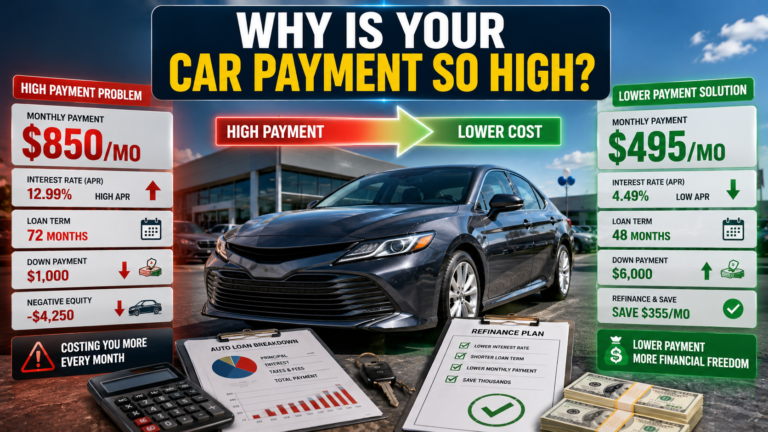
A high auto loan interest rate can make an otherwise affordable car surprisingly expensive.
When I look at a car loan, I don’t focus only on the monthly payment. A payment can look manageable while the interest rate quietly adds thousands of dollars to the total cost of the vehicle.
The good news is that your initial auto loan rate doesn’t necessarily have to be the rate you keep forever. Depending on your credit, income, loan balance, vehicle, and current market offers, there may be several ways to reduce your borrowing cost.
Here are some practical ways to lower your auto loan interest rate and potentially save money.
Check Your Credit Before Looking for a Lower Rate

Your credit profile is one of the factors lenders can consider when setting an auto loan interest rate. Lenders may also consider your income, existing debts, loan amount, down payment, loan term, and the vehicle you’re financing. (Consumer Financial Protection Bureau)
If your credit has improved since you originally financed your car, that could give you an opportunity to qualify for better terms.
Before applying for a new loan or refinancing, review your credit reports and look for inaccurate information. The CFPB recommends checking your credit reports before shopping for an auto loan and disputing errors you find. (Consumer Financial Protection Bureau)
This is a step I’d take before doing anything else. There’s little point in applying for refinancing without knowing what lenders are likely to see.
Shop Around With Multiple Lenders
One of the most effective ways to find a lower rate is simply to compare offers.
You don’t have to get your financing from the same lender that currently holds your loan. Banks, credit unions, and other lenders may offer different rates for the same borrower.
The CFPB recommends getting quotes from multiple lenders and comparing their offers. (Consumer Financial Protection Bureau)
For example, you might compare:
- Your current lender
- A local credit union
- A national bank
- An online lender
Don’t assume the first offer you receive is the best one.
Even a small difference in APR can matter when you’re borrowing tens of thousands of dollars.
Consider Refinancing Your Auto Loan
If your current interest rate is high, refinancing may be worth investigating.
Refinancing means taking out a new loan to pay off your existing auto loan. The new loan ideally has a lower interest rate or better terms.
For example, if your credit was weak when you bought your car but has improved since then, you may now qualify for a more competitive rate.
The CFPB notes that refinancing may help borrowers obtain a lower interest rate, although extending the loan term can increase the total interest paid. (Consumer Financial Protection Bureau)
That’s an important distinction.
A refinance that lowers your monthly payment isn’t automatically a good deal.
Look at the total amount you’ll pay, not just the new monthly payment.
Try a Credit Union
Credit unions are worth including in your comparison.
You may already have access to one through your employer, community, military affiliation, or another eligibility relationship. Credit unions can offer auto loans alongside banks and other lenders.
The CFPB specifically recommends comparing offers from banks and credit unions rather than assuming dealership financing will provide the best rate. (Consumer Financial Protection Bureau)
Before applying, ask about the APR, loan term, fees, and any membership requirements.
A slightly lower rate can be valuable, but only if the overall loan terms are favorable.
Negotiate the Interest Rate
Many people don’t realize that an auto loan interest rate can sometimes be negotiated.
This is particularly important when financing through a dealership.
According to the CFPB, dealers may receive a lower “buy rate” from a lender and then offer the consumer a higher contract rate. That difference can sometimes be negotiated. (Consumer Financial Protection Bureau)
If you already have a preapproval from a bank or credit union, you have something useful to bring to the conversation.
You can ask the dealer whether they can beat your existing APR.
You don’t need to be aggressive. A simple question such as “Can you beat this rate?” can be enough to start the discussion.
Make a Larger Down Payment
If you’re buying a vehicle rather than refinancing an existing loan, a larger down payment can reduce the amount you need to borrow.
A smaller loan means less interest paid in absolute dollars.
The CFPB also notes that a larger down payment can reduce the loan-to-value ratio and may help lower the interest rate a lender offers. (Consumer Financial Protection Bureau)
However, I wouldn’t empty my savings just to make a larger down payment.
You still need money for emergencies, insurance, maintenance, and unexpected expenses.
The goal is to reduce the loan without leaving yourself financially vulnerable.
Choose a Shorter Loan Term
A shorter loan term can reduce the total amount of interest you pay because you’re making fewer payments.
For example, a 48-month loan may cost more each month than a 72-month loan, but the shorter loan can result in substantially less interest over the full repayment period.
The CFPB warns that longer auto-loan terms can reduce monthly payments while increasing the total interest paid. (Consumer Financial Protection Bureau)
So when comparing loans, don’t ask only:
“What is my monthly payment?”
Also ask:
“How much will I pay in total?”
That’s the number that tells you what the financing is really costing.
Improve Your Debt-to-Income Position
Lenders may consider your income and existing debts when evaluating an auto loan. (Consumer Financial Protection Bureau)
If your financial situation has improved since you took out the original loan, refinancing could become more attractive.
For example, you may have paid down credit-card balances, received a raise, or eliminated another monthly debt.
You don’t necessarily need a dramatic financial transformation. Even a meaningful improvement in your overall financial profile can be worth discussing with lenders.
Check Whether Your Current Loan Has a Prepayment Penalty
Before refinancing, read your existing loan agreement.
Find out whether your lender charges a fee for paying off the loan early.
A refinance usually involves paying off the old loan, so an early-payoff fee could affect the savings.
Ask your current lender for an exact payoff amount before comparing refinance offers.
Then calculate the difference between what you currently owe and what the new loan would cost.
Don’t Be Distracted by a Lower Monthly Payment
This is probably the most important point in the entire article.
Suppose you currently have 36 months left on your auto loan.
A refinance could stretch the remaining balance over 60 months. Your monthly payment might drop significantly.
That can sound great.
But if the new loan has a longer repayment period, you could end up paying more interest even with a lower monthly payment.
The FTC recommends comparing the APR, loan term, and total amount financed rather than focusing only on the monthly payment. (Consumer Advice)
A lower payment is useful when it comes with genuinely better overall terms—not simply because you’ve extended the debt.
Ask Your Current Lender for a Better Rate
Before moving your loan to another lender, it doesn’t hurt to contact your existing lender.
Tell them you’ve found better rates elsewhere and ask whether they can offer a lower rate or refinance your existing balance.
They may say no.
But if they do offer improved terms, you may avoid some of the work involved in switching lenders.
Just make sure you still compare the offer with outside options.
Compare APR, Not Just the Interest Rate
When comparing loans, pay attention to the Annual Percentage Rate (APR).
The CFPB explains that the interest rate represents the cost of borrowing, while APR incorporates the interest rate plus certain additional loan fees. (Consumer Financial Protection Bureau)
That makes APR useful when comparing financing offers.
If one lender offers a 7% interest rate and another offers 7.25%, don’t automatically assume the first loan is cheaper. Look at the APR, fees, loan term, and total repayment amount.
You want to compare the complete cost of each offer.
Be Careful With Add-Ons
When you’re refinancing or buying a vehicle, you may be offered additional products or services.
Some add-ons can increase the amount you’re financing and therefore increase your overall borrowing cost.
The FTC recommends reviewing financing paperwork carefully and comparing the total cost of the deal rather than focusing only on the monthly payment. (Consumer Advice)
If you don’t understand an add-on, ask what it costs and whether it’s optional.
Don’t agree to something simply because you’re already sitting in the finance office and want to finish the transaction.
When Is Refinancing Probably Worth Considering?
There isn’t one universal rule, but refinancing is worth investigating when several things have changed in your favor.
For example:
- Your credit has improved
- Your income has increased
- Your existing debts have decreased
- You can qualify for a lower APR
- Your current loan has a high interest rate
- Your vehicle still meets the new lender’s requirements
- The savings outweigh any refinancing costs
The important part is running the numbers before signing anything.
Lowering your auto loan interest rate isn’t necessarily about finding a magical lender offering an unusually low rate.
It’s usually about improving your negotiating position and comparing enough alternatives to recognize a better deal.
Check your credit, compare banks and credit unions, consider refinancing, negotiate with dealers, and look at shorter loan terms when you can comfortably afford the payment.
Most importantly, compare the APR and total repayment cost, not just the monthly payment.
A lower interest rate can save you money, but the best loan is the one that combines a competitive rate with a manageable payment and a reasonable repayment period.
If you already have an auto loan, don’t assume the terms are permanent. Your financial situation can change, and it may be worth checking whether those changes qualify you for a better deal.