When you apply for a loan, one of the first things a lender usually wants to know is whether you have enough reliable income to make the monthly payments. But what if you have substantial savings and investments but don’t currently earn a traditional paycheck?
This situation is common for retirees, self-employed borrowers, people between jobs, investors, and individuals who have built significant savings over time.
So, can savings count as income for a loan?
The answer is generally not in the same way as regular employment income. Having money in a savings account can strengthen your overall financial profile, but a lender may not treat the balance itself as income. However, certain assets can potentially produce income, and some lenders may consider that income when evaluating a loan application.
The exact rules depend on the lender, loan type, your financial situation, and the source of the money.
Is Savings Considered Income for a Loan?
Generally, the balance in a savings account is not considered income.
For example, suppose you have $100,000 in a savings account but no current employment income. The $100,000 is an asset. It doesn’t automatically become $100,000 of annual income simply because you have access to it.
Lenders typically distinguish between assets and income.
Income is money you regularly receive, such as:
- Salary
- Wages
- Self-employment income
- Retirement income
- Pension payments
- Social Security benefits
- Rental income
- Investment income
Assets, on the other hand, include things such as:
- Savings accounts
- Checking accounts
- Certificates of deposit
- Stocks
- Bonds
- Retirement accounts
- Real estate
Having substantial assets can still help demonstrate financial strength, but the lender may evaluate them separately from your income.
Can Interest Earned From Savings Count as Income?
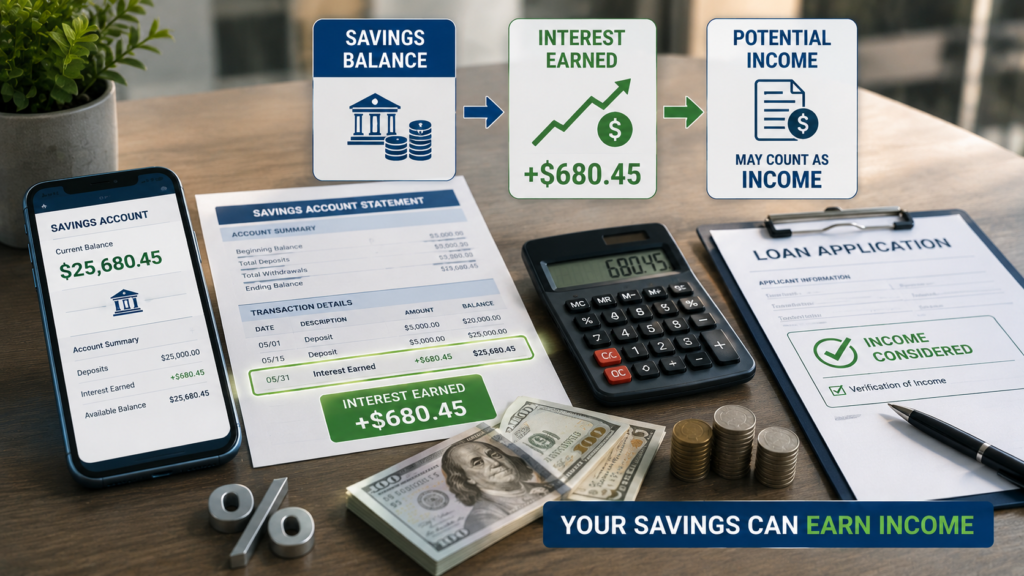
Potentially, yes.
If your savings account generates interest, that interest may be considered income if it can be properly documented and meets the lender’s requirements.
For example, suppose you have a large savings balance that generates $4,000 in interest during a year.
The savings balance itself is an asset. The interest earned may be considered income.
A lender may ask for documentation showing the amount and history of the interest income. Depending on the loan program, simply having a large balance may not be enough.
This distinction is important:
Savings balance = asset
Interest generated by savings = potentially qualifying income
Can Savings Help You Qualify for a Loan Without a Job?
Sometimes, but it depends heavily on the lender and loan program.
If you don’t have employment income, a lender may look for other legitimate sources of income.
For example, a borrower could potentially qualify using income from:
- Retirement accounts
- Pensions
- Social Security
- Investments
- Rental properties
- Annuities
- Trust distributions
- Other documented recurring sources
Savings can strengthen the application by showing that you have financial reserves, but the lender may still require an acceptable source of repayment.
In other words, having $200,000 in the bank doesn’t necessarily replace the need for qualifying income.
Can You Use Assets Instead of Income?
Some loan programs may allow borrowers to qualify using assets or income derived from assets, depending on the specific rules.
This is sometimes relevant for borrowers who have significant wealth but relatively little traditional employment income.
For example, a retiree might have:
- $500,000 in retirement accounts
- $150,000 in taxable investments
- $75,000 in savings
Even though the person no longer receives a paycheck, they may have qualifying income from retirement distributions, investments, pension payments, or other sources.
The lender may evaluate both the income and assets under the applicable underwriting requirements.
What Is Asset Depletion?
Asset depletion is a method some lenders may use to determine qualifying income from eligible assets.
Instead of treating the entire asset balance as income, the lender may apply a specific calculation to determine whether the assets can support a certain amount of monthly income.
The calculation can vary based on:
- Loan type
- Lender guidelines
- Asset type
- Borrower’s age
- Loan term
- Account restrictions
- Applicable underwriting rules
For example, a lender may determine that a portion of eligible assets can be converted into a calculated monthly income amount.
This approach can be particularly relevant for borrowers with substantial investments or retirement assets but limited employment income.
However, not every lender offers asset-depletion underwriting, and not every type of account will necessarily qualify.
Do Lenders Look at Your Savings Account?
Yes.
Even when savings aren’t counted as income, lenders may review your bank statements or account balances to understand your financial position.
Savings can help demonstrate:
- Financial reserves
- Ability to cover unexpected expenses
- Down-payment funds
- Closing costs
- Post-closing reserves
- Overall financial stability
A larger cash reserve can make an application look stronger in certain situations.
But remember that lenders generally don’t evaluate an application based on savings alone.
They may consider your complete financial profile, including income, credit history, debts, assets, and the requested loan amount.
Can Savings Help With a Mortgage?
Savings can play an important role in mortgage qualification even though the balance itself usually isn’t treated as regular employment income.
For example, savings can be used for:
- Down payment
- Closing costs
- Required reserves
- Emergency funds
- Cash needed at closing
Some mortgage programs may also have specific rules for using assets as a source of qualifying income.
The requirements can differ significantly between conventional mortgages, government-backed loans, and other loan programs.
If you’re applying for a mortgage without traditional employment income, ask the lender specifically whether it accepts asset-based or asset-depletion qualification.
Can Savings Count as Income for a Personal Loan?
Personal-loan underwriting varies considerably by lender.
Some lenders may require documented income, while others may consider a broader financial picture.
If your savings generate interest or investment income, that income may potentially be included if you can document it.
However, simply having a large balance in a savings account doesn’t necessarily mean a lender will treat that balance as monthly income.
Always check the lender’s definition of qualifying income before assuming your savings will satisfy its requirements.
Can Savings Count as Income for an Auto Loan?
Auto lenders generally focus on your ability to make the monthly payment.
If you don’t have employment income, the lender may consider other documented income sources depending on its underwriting policies.
Savings can be helpful because they may:
- Support a larger down payment
- Reduce the amount borrowed
- Demonstrate financial reserves
- Reduce the lender’s overall risk in some circumstances
But the lender may still require proof of income.
If you’re buying a car using money from savings, that’s different from using savings as income to qualify for financing.
For example, using $10,000 from your savings account as a down payment reduces the amount you need to finance. It doesn’t necessarily mean the remaining savings balance qualifies as monthly income.
What Documents Can Prove Savings and Asset Income?
If you’re relying on assets or income generated by assets, documentation is important.
Depending on the lender and loan type, you may be asked for:
- Recent bank statements
- Investment account statements
- Retirement account statements
- Tax returns
- 1099 forms
- Pension statements
- Social Security documentation
- Brokerage statements
- Proof of recurring distributions
The lender may also ask for additional documents to verify the source and stability of the funds.
Providing organized financial records can make the application process easier.
What If Your Savings Are Very Large?
A large savings balance can certainly strengthen your financial position, but it doesn’t automatically guarantee loan approval.
For example, someone with $300,000 in savings but significant monthly debts could still face qualification challenges.
Another borrower might have $75,000 in savings, stable income, excellent credit, and manageable debt and receive a stronger loan offer.
Lenders generally look at the whole financial picture, not one number.
Should You Use Your Savings to Get a Smaller Loan?
Sometimes using savings for a larger down payment can make sense.
Borrowing less can reduce:
- Monthly payments
- Total interest
- Loan-to-value ratio
- Overall debt burden
However, you shouldn’t use so much of your savings that you have no emergency cushion afterward.
A loan may be easier to qualify for with a larger down payment, but maintaining enough cash for unexpected expenses is also important.
The right balance depends on your income, expenses, financial goals, and the type of loan you’re seeking.
What If You Have No Income but Significant Savings?
This is where lender policies become particularly important.
If you have no current employment income but substantial assets, ask potential lenders whether they consider:
- Asset depletion
- Investment income
- Retirement distributions
- Pension income
- Social Security
- Interest income
- Other documented recurring income
You may find that one lender’s requirements are different from another’s.
Don’t assume that every lender evaluates assets in the same way.
Savings can help you qualify for a loan, but a savings balance usually isn’t treated as regular income.
The money sitting in your bank account is generally considered an asset. However, income generated from those assets—such as interest, dividends, investment income, or qualifying distributions—may potentially be considered income if the lender’s rules allow it and you can provide sufficient documentation.
For borrowers without traditional employment income, some lenders may also consider eligible assets through an asset-depletion approach.
If you’re applying for a loan based largely on savings and investments, the best approach is to ask lenders exactly what they consider qualifying income and which assets they accept. Gather your financial statements and income documentation before applying, and compare the requirements of multiple lenders.
Most importantly, don’t assume that having a large bank balance guarantees approval. Loan qualification is usually based on the combination of income, assets, debts, credit history, and ability to repay.
Understanding that distinction before you apply can help you choose the right loan and avoid surprises during underwriting.