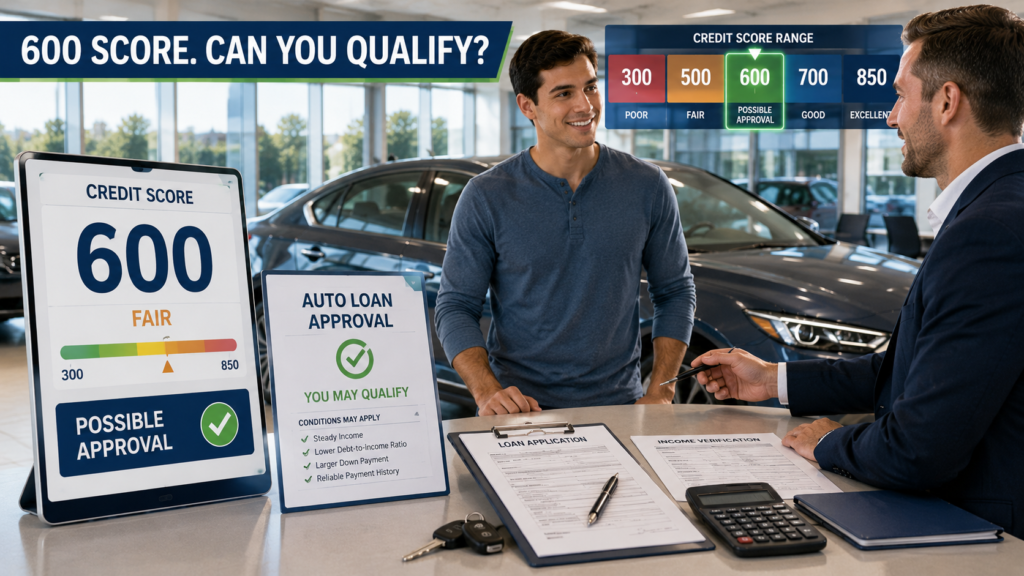
A credit score around 600 can make getting a car loan more challenging, but it does not automatically mean you can’t finance a vehicle. Many lenders work with borrowers across different credit ranges, although borrowers with lower credit scores may face higher interest rates, larger down-payment requirements, or stricter loan terms.
If your credit score is around 600, the goal shouldn’t simply be to find a lender willing to approve you. You should also focus on finding a loan that fits your budget and minimizing the total cost of borrowing.
Here’s how to improve your chances of getting a car loan with a 600 credit score.
Is a 600 Credit Score Good Enough for a Car Loan?
Yes, it can be.
A 600 credit score generally falls in the lower-credit range, but lenders don’t make their decision based on your score alone. They may also consider your income, employment history, existing debts, down payment, vehicle, loan amount, and previous credit history.
Two people with the same credit score could receive completely different loan offers because their overall financial situations are different.
For example, a borrower with a 600 score but steady income, manageable debt, and a substantial down payment may look less risky to a lender than someone with the same score who has unstable income and significant outstanding debt.
So, don’t assume that a 600 score means automatic rejection.
Check Your Credit Before Applying
Before submitting multiple loan applications, review your credit information.
Look for:
- Incorrect account information
- Accounts that don’t belong to you
- Incorrect payment history
- Outdated negative information
- Incorrect balances
- Duplicate accounts
If you discover an error, consider addressing it before applying for an auto loan.
You should also understand your current debts and monthly obligations. This gives you a better idea of how much additional debt you can realistically handle.
Set a Realistic Car Budget
One of the biggest mistakes borrowers with lower credit can make is focusing on the maximum amount a lender is willing to approve.
A lender might approve a loan that produces a monthly payment you technically can make, but that doesn’t necessarily mean the vehicle is affordable for your overall financial situation.
Your car budget should account for more than the loan payment.
Remember to consider:
- Monthly loan payment
- Insurance
- Fuel
- Maintenance
- Registration
- Taxes and fees
- Parking
- Unexpected repairs
A less expensive vehicle can sometimes be a better financial choice than stretching your budget for a newer or more expensive car.
Save for a Larger Down Payment
A larger down payment can be especially helpful when your credit score is around 600.
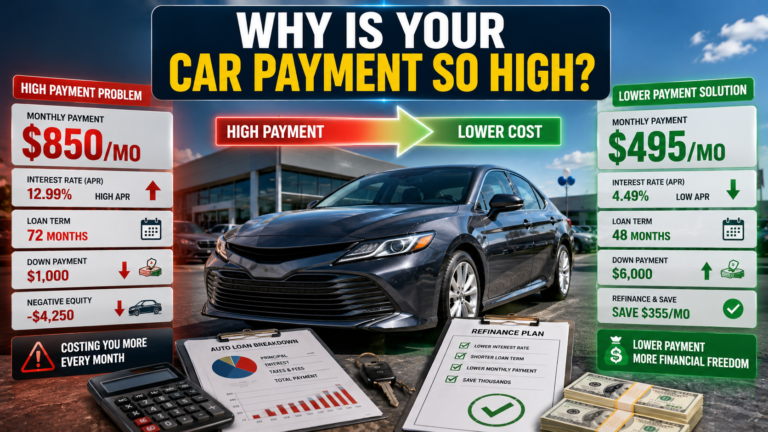
For example, suppose you want to buy a $25,000 vehicle. If you put $5,000 down, you only need to finance $20,000 before taxes, fees, and other financed costs.
Borrowing less can reduce your monthly payment and the amount of interest you pay over the life of the loan.
A larger down payment can also reduce the lender’s risk because you have more money invested in the vehicle from the beginning.
However, don’t empty your savings just to increase your down payment. Maintaining an emergency fund is still important.
Get Preapproved Before Shopping
Getting preapproved can help you understand what type of financing you may qualify for before you visit a dealership.
You can compare potential financing through different types of lenders, including:
- Banks
- Credit unions
- Online auto lenders
- Dealership financing
A preapproval can give you a useful benchmark for comparing dealer financing.
For example, if an outside lender offers you a particular APR and loan term, you can compare that offer against what the dealership provides.
This puts you in a better position to evaluate the financing instead of accepting the first offer presented to you.
Compare Multiple Lenders
Don’t assume every lender will treat a 600 credit score the same way.
Auto lenders use different underwriting models and may place different importance on factors such as income, debt, credit history, vehicle type, and loan-to-value ratio.
That’s why shopping around can matter.
When comparing offers, look at:
- APR
- Loan term
- Monthly payment
- Total interest
- Required down payment
- Loan fees
- Prepayment terms
- Vehicle restrictions
The lowest monthly payment isn’t necessarily the best deal.
A longer loan term can reduce your payment while increasing the total amount of interest you pay.
Consider a Credit Union
Credit unions are worth considering if you’re eligible for membership.
Some credit unions offer auto loans to borrowers with different credit profiles, and their rates and underwriting requirements can differ from traditional banks and other lenders.
However, approval isn’t guaranteed simply because you apply through a credit union.
Compare the actual offer you receive rather than choosing a lender based solely on reputation or advertised rates.
Consider a Cosigner Carefully
A qualified cosigner with stronger credit may improve your chances of approval or help you qualify for a lower interest rate.
A cosigner agrees to take responsibility for the debt if you fail to make the required payments.
That means this isn’t a favor without financial consequences.
Before asking someone to cosign, both parties should understand that missed payments can affect the cosigner’s credit and finances as well.
If you can qualify for a reasonable loan without a cosigner, that may be preferable.
Choose the Right Vehicle
The vehicle you purchase can affect your financing options.
A lender may consider factors such as:
- Vehicle age
- Mileage
- Purchase price
- Vehicle value
- New versus used status
- Loan-to-value ratio
A relatively inexpensive, reliable vehicle may be easier to finance responsibly than an expensive vehicle that requires a large loan.
You should also be careful with very old vehicles. While a lower purchase price can look attractive, some lenders have restrictions on the age or mileage of vehicles they finance.
Should You Buy a New or Used Car With a 600 Credit Score?
There isn’t a universal answer.
A used car may have a lower purchase price, which can reduce the amount you need to borrow. However, used-car loans can sometimes have higher interest rates than loans for new vehicles.
New vehicles may qualify for promotional financing in some circumstances, but they also tend to cost more and can depreciate quickly.
Instead of choosing based only on whether a car is new or used, compare the total cost of the vehicle and financing.
A slightly higher interest rate on a much smaller loan could potentially cost less overall than a lower rate on a much larger loan.
Improve Your Credit Before Applying if You Can
If you don’t need a vehicle immediately, taking some time to strengthen your credit could potentially improve your financing options.
Depending on your circumstances, you might focus on:
- Making all payments on time
- Reducing credit card balances
- Avoiding unnecessary new debt
- Checking credit reports for errors
- Keeping older accounts in good standing
Credit improvement takes time, and there is no guaranteed number of points your score will increase by a certain date.
But even a stronger credit profile can potentially give you access to better financing opportunities.
Be Careful With Buy-Here-Pay-Here Financing
Some dealerships specialize in financing borrowers who have difficulty qualifying through traditional lenders.
These arrangements can provide an option for people with poor or limited credit, but you should carefully review the complete loan terms.
Pay particular attention to:
- APR
- Total repayment amount
- Payment frequency
- Fees
- Vehicle price
- Down payment
- Late-payment consequences
- Repossession terms
Don’t judge the deal solely by whether the dealer says you are “approved.”
An approval can still be an expensive loan.
Watch Out for Long Loan Terms
A long loan term can make an expensive vehicle appear affordable.
For example, extending a loan from four years to six or seven years can reduce the monthly payment, but you may pay substantially more interest over time.
With a lower credit score, the combination of a high APR and long loan term can become particularly expensive.
Before agreeing to the loan, calculate how much you will pay from beginning to end.
Ask yourself:
“If I keep this loan until it’s completely paid off, how much will this car actually cost me?”
That number is often more useful than the monthly payment.
Don’t Apply Everywhere at Random
Shopping for financing is important, but submitting applications without a plan isn’t ideal.
Many auto-loan inquiries made within a focused shopping period may be treated differently by credit-scoring models than numerous unrelated credit applications spread over a long period. However, the exact treatment can vary by scoring model.
A practical approach is to compare lenders within a relatively short shopping window and ask whether they can provide a rate estimate or prequalification without a full application when available.
What to Do If You’re Denied
A loan denial isn’t necessarily the end of the process.
If one lender says no, you can review the reason for the decision and consider whether another lender has different eligibility criteria.
You could also:
- Increase your down payment
- Reduce the amount you’re trying to borrow
- Choose a less expensive vehicle
- Add a qualified cosigner
- Improve your credit first
- Reduce existing debts
- Compare additional lenders
Avoid immediately accepting a very expensive loan simply because another lender rejected your application.
How Much Should You Put Down With a 600 Credit Score?
There is no universal down-payment amount that guarantees approval.
A larger down payment can reduce the loan amount and may improve the overall financing picture, but the right amount depends on your savings, income, vehicle price, and other financial obligations.
The important thing is to avoid putting so much money into the car that you have nothing left for emergencies.
A healthy financial plan should account for both the purchase and what happens after you drive the vehicle home.
Getting a car loan with a 600 credit score is possible, but you should expect financing to require more careful comparison.
Don’t focus exclusively on approval. Focus on finding a loan that you can comfortably repay.
Start by checking your credit, setting a realistic vehicle budget, saving an appropriate down payment, and comparing multiple lenders. Getting preapproved can also give you a useful benchmark before negotiating with a dealership.
If possible, consider improving your credit before buying. A stronger credit profile may help you qualify for better financing terms.
Most importantly, compare APR, loan term, fees, monthly payment, and total repayment cost rather than choosing a loan based only on the payment advertised by the dealer.
With a 600 credit score, being prepared can make a major difference. The goal isn’t simply to get behind the wheel—it’s to do so without taking on a car loan that creates unnecessary financial pressure.