Car insurance is something many drivers don’t think about until they need it. But what happens if your policy expires and you go just one day without coverage?
A one-day lapse in car insurance can be more serious than it sounds. Even if you don’t drive the vehicle during that period, an insurance lapse can potentially affect your finances, future premiums, registration status, and ability to maintain continuous coverage.
The exact consequences depend on your state, insurance company, reason for the lapse, and whether you drove the vehicle while uninsured. Some insurers may also have a grace period for certain situations, but you should never assume that a grace period means you are automatically covered.
Here’s what you need to know if your car insurance expires for one day.
Can Car Insurance Really Expire for Just One Day?
Yes. If your policy’s coverage ends and a new policy or renewal hasn’t taken effect, you can have a lapse in coverage—even if the gap lasts only one day.
For example, suppose your policy expires at 12:01 a.m. on August 15 and your renewal doesn’t begin until August 16. Unless your insurer confirms that coverage continues or the policy has been reinstated without a lapse, you could technically have a period without insurance.
The important detail is the effective date and time of your policy, not simply the date printed on your insurance card.
If you’re unsure whether your policy actually expired, contact your insurance company and ask them to confirm the exact coverage status.
What Happens If You Don’t Drive During That One Day?
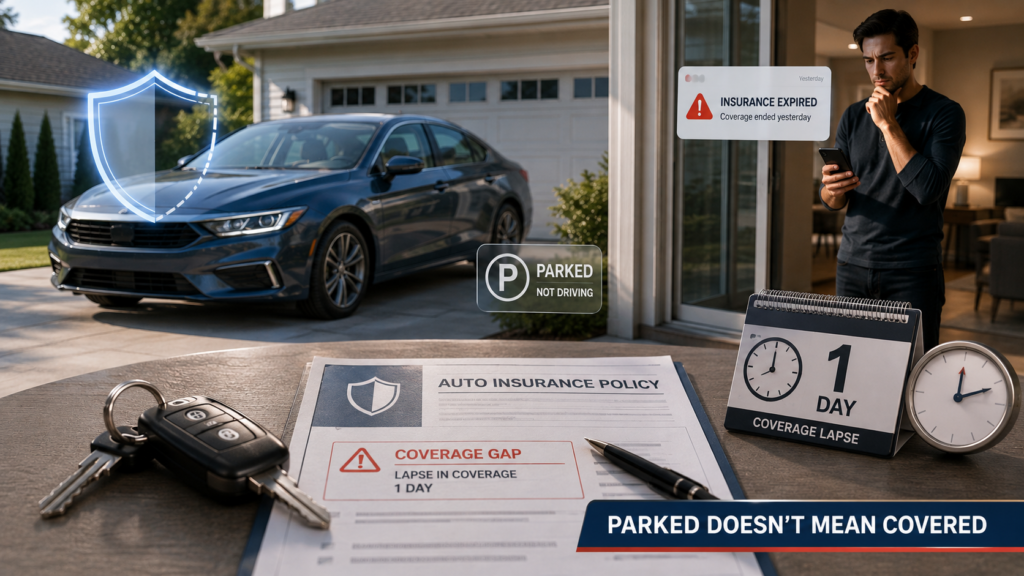
Not driving is significantly better than getting into an accident while uninsured, but a lapse can still matter.
If the vehicle remains parked and nothing happens, you may not have an immediate financial loss. However, the lapse itself could still be recorded by your insurer or affect your insurance history.
Depending on your state and circumstances, a lapse could potentially lead to:
- Registration-related problems
- State penalties
- Higher future premiums
- Difficulty qualifying for certain insurance rates
- Loss of discounts for continuous coverage
The consequences aren’t identical everywhere.
Some insurers may treat a very short lapse differently from a longer uninsured period, particularly if you promptly reinstate your policy.
What If You Drive During the One-Day Lapse?
This is where the situation becomes much more serious.
If your insurance has genuinely expired, you generally should not drive the vehicle until you have confirmed that valid coverage is active.
If you cause an accident while uninsured, you could potentially be personally responsible for:
- Damage to another vehicle
- Damage to property
- Medical expenses
- Legal costs
- Other financial claims resulting from the accident
Even a minor accident can become expensive quickly.
If another driver causes an accident, the situation can also become complicated because you don’t have your own active coverage to provide the protections your policy would normally offer.
Can You Be Fined for a One-Day Insurance Lapse?
Possibly.
Auto insurance requirements are primarily regulated at the state level, so penalties for driving without required insurance vary considerably.
Depending on the state, consequences can include:
- Fines
- Registration suspension
- License-related penalties
- Reinstatement fees
- Required proof of insurance
- Other administrative penalties
Some states have systems that can identify when a registered vehicle doesn’t have required insurance, even if the owner wasn’t pulled over.
That’s why you shouldn’t assume that a one-day lapse is automatically ignored.
Will a One-Day Lapse Increase Your Insurance Premium?
It can, but there isn’t a universal rule.
Insurance companies evaluate risk differently. Some may consider a short lapse less significant, particularly if you quickly restore coverage. Others may increase your premium or remove a continuous-insurance discount.
The effect can depend on:
- How long the lapse lasted
- Why coverage ended
- Whether you drove during the lapse
- Whether you’ve had previous lapses
- Your driving history
- Your insurance company
- Your state
A one-day lapse is generally less concerning than a lengthy period without coverage, but that doesn’t mean it has no consequences.
Does a Grace Period Protect You?
This is one of the biggest misconceptions about expired car insurance.
Some insurance companies may provide a limited grace period for certain circumstances, such as making a late payment or processing a renewal. However, a grace period does not automatically mean you have unlimited coverage after your policy’s expiration date.
The terms depend on your insurer and state.
Before assuming you’re covered, contact your insurer and ask:
- Is my policy currently active?
- What is the exact expiration date and time?
- Has my policy been canceled or simply not renewed?
- Can it be reinstated?
- Will reinstatement be backdated?
- Will there be a lapse on my insurance record?
Getting a clear answer can prevent a potentially expensive mistake.
What Should You Do If Your Insurance Expired Yesterday?
If you discover that your policy expired yesterday, don’t panic—but act quickly.
First, avoid driving the vehicle until you confirm that coverage is active.
Then contact your insurance company immediately.
Explain that you believe your policy may have expired and ask whether they can reinstate it.
Depending on the circumstances, the insurer may be able to reinstate the policy without a lapse, or it may require you to purchase new coverage.
Don’t assume that making a payment automatically restores coverage from the previous date.
Ask the insurer to confirm the effective date of your coverage in writing or through your policy documentation.
What If You Forgot to Pay Your Premium?
A missed payment is one of the most common reasons for an insurance lapse.
If your payment was late, contact the insurance company as soon as possible.
Depending on the policy and applicable rules, the insurer may have already canceled the policy, or it may still be eligible for reinstatement.
If the insurer reinstates the policy, ask whether there was any actual gap in coverage.
This distinction is important.
There’s a major difference between paying late while coverage remains active and having a policy officially canceled and then buying new coverage later.
What If Your Policy Was Canceled Without You Realizing It?
Sometimes drivers don’t realize their coverage has ended.
A cancellation notice, returned payment, expired card, communication problem, or billing issue can result in an unexpected coverage problem.
That’s why it’s important to keep your contact information and payment information updated with your insurer.
If you receive a cancellation or non-renewal notice, don’t ignore it.
Contact the insurer and determine exactly when coverage ends and what you need to do to maintain continuous insurance.
Can You Buy New Insurance After a One-Day Lapse?
Yes, you can generally apply for new car insurance after a lapse, although the insurer may ask questions about the gap.
You may be asked:
- Why did the policy lapse?
- How long were you uninsured?
- Were you driving during the lapse?
- What insurer provided your previous coverage?
- Do you currently have valid insurance?
Answer honestly.
Trying to hide a lapse can create bigger problems than simply explaining a short coverage gap.
How to Prevent a One-Day Insurance Lapse
Preventing the problem is much easier than dealing with its consequences.
Consider these simple habits:
Set Up Automatic Payments
Automatic payments can help prevent missed premium due dates, although you should still monitor your bank account and insurance notices.
Turn On Renewal Notifications
Keep email, text, or app notifications enabled if your insurer provides them.
Check Your Policy Before the Expiration Date
Don’t wait until the last day to discover that your payment failed or your renewal requires action.
Keep Your Contact Information Updated
Make sure your insurer has your current phone number, email address, and mailing address.
Keep Proof of Insurance Available
Having your current insurance information readily accessible makes it easier to verify your coverage when necessary.
Should You Drive to an Insurance Office After Your Policy Expires?
No.
If you’re genuinely uninsured, don’t drive the vehicle to an insurance office simply to purchase coverage.
Instead, contact the insurer online or by phone, or arrange another way to reach the office.
Even a short drive while uninsured can expose you to significant financial and legal risk if something goes wrong.
What If You Had an Accident During the One-Day Lapse?
If an accident occurred while you believe your policy was expired, contact the insurance company immediately and explain the situation.
Don’t assume you’re uninsured until the insurer confirms the policy’s status.
There can be differences between:
- A policy that expired
- A policy canceled for nonpayment
- A policy pending reinstatement
- A renewal that hasn’t processed correctly
- A policy that was reinstated retroactively
If you were involved in an accident, you may also need to understand your state’s legal requirements and consider getting professional legal advice if significant injuries or property damage are involved.
A one-day car insurance lapse may not automatically result in severe consequences, but you shouldn’t treat it as harmless.
If your policy genuinely expired, avoid driving until you confirm that valid coverage is active. Contact your insurer immediately and ask whether the policy can be reinstated and whether there was actually a gap in coverage.
The consequences of a lapse can vary depending on your state, insurer, driving activity, and individual circumstances. You could potentially face higher premiums, loss of discounts, registration issues, or other penalties.
The most important thing is to act quickly.
If you discover the lapse before driving, you may be able to resolve the situation before anything happens. Never assume you’re covered simply because the lapse is only one day or because you believe your insurer offers a grace period.
Confirm your coverage status directly with your insurer, understand the effective date of your policy, and keep your insurance active continuously whenever you’re required to maintain coverage.