Starting a business with little or no money is one of the biggest challenges new entrepreneurs face. You may have a strong business idea, a realistic plan, and the motivation to make it work, but lenders still want to know one thing: how will the loan be repaid?
The good news is that having very little cash does not automatically mean you cannot get startup financing. However, getting a business loan with literally no money, no credit, no assets, and no proven ability to repay is difficult.
When I look at startup financing, I think the better question is not, “Which lender will give me money with nothing?” It is, “What can I show a lender that reduces the risk of lending to my new business?”
That might be strong personal credit, industry experience, a detailed business plan, collateral, a qualified cosigner, a realistic revenue forecast, or a combination of these.
Can You Get a Startup Business Loan With No Money?
Potentially, yes.
But “no money” can mean different things.
If you mean you don’t have enough cash to fully fund your startup, you may still have financing options. If you mean you have no cash, no credit, no collateral, no income, and no ability to contribute anything to the business, getting a traditional business loan will be much harder.
The U.S. Small Business Administration (SBA) says lenders generally look at factors such as creditworthiness, the ability to repay, business purpose, and other eligibility requirements. SBA-backed financing does not mean automatic approval.
That’s why preparation matters so much for a brand-new business.
Start With a Business Plan
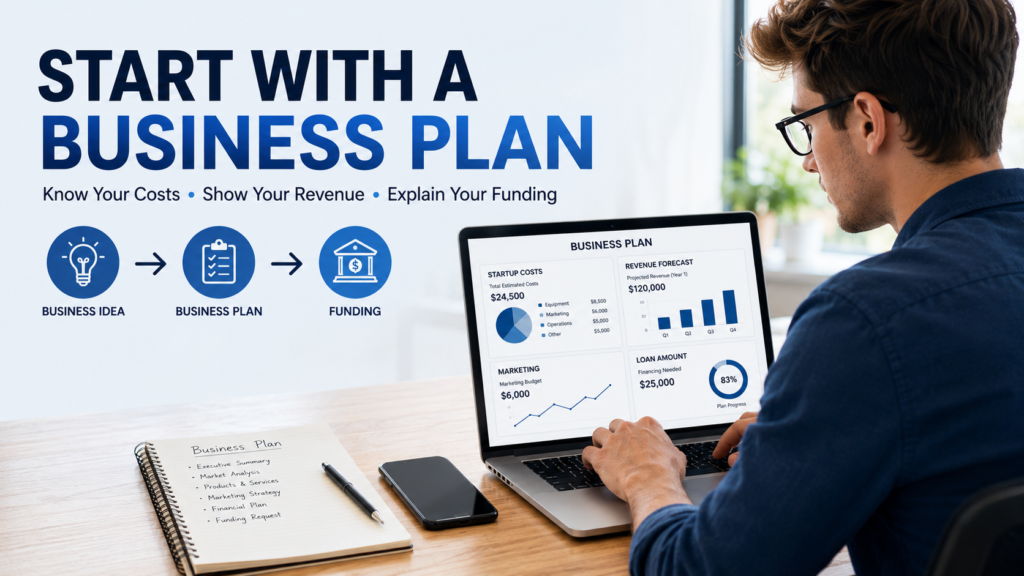
If I were applying for startup financing with limited cash, the first thing I’d work on would be the business plan.
A lender needs to understand what you’re building, who will pay for it, how much money you need, and how the business is expected to generate enough cash to repay the loan.
Your plan should explain:
- What your business sells
- Who your target customers are
- How you will attract customers
- Startup costs
- Expected monthly expenses
- Pricing
- Expected revenue
- How much funding you need
- Exactly how the money will be used
- How you expect to repay the loan
The SBA recommends providing a detailed explanation of how requested funds will be used and including financial projections with a funding request.
A vague statement like “I need $50,000 to start my business” isn’t nearly as convincing as explaining that $15,000 will purchase equipment, $10,000 will cover initial inventory, $5,000 will fund marketing, and the remainder will provide working capital.
Consider an SBA Microloan
For some startups, an SBA Microloan may be more realistic than trying to qualify for a large bank loan.
The SBA Microloan program provides loans of up to $50,000, with the average microloan around $13,000. Funds can generally be used for working capital, inventory, supplies, furniture, fixtures, machinery, and equipment.
These loans are provided through SBA-approved intermediary lenders, which are often nonprofit community-based organizations.
One advantage for a new entrepreneur is that you’re dealing with a lender specifically involved in smaller business financing rather than approaching a bank only for a large traditional business loan.
However, don’t assume that “microloan” means “no requirements.”
Intermediary lenders set their own credit requirements, and SBA notes that lenders may require collateral and a personal guarantee.
Look at SBA 7(a) Loans Too
The SBA 7(a) program is another major source of small-business financing.
It can be used for purposes including working capital, equipment, supplies, real estate, and other eligible business needs. The maximum 7(a) loan amount is currently $5 million.
For a brand-new business, however, getting a large 7(a) loan without demonstrating repayment ability can be challenging.
SBA eligibility generally requires the business to be for-profit, located in the United States, small under SBA standards, creditworthy, and able to demonstrate a reasonable ability to repay.
So I wouldn’t approach a 7(a) loan expecting the SBA guarantee to replace a strong application.
The guarantee helps participating lenders manage risk, but the lender still evaluates the borrower.
Use Your Personal Credit Carefully
A new business usually doesn’t have much of a credit history.
That means lenders may look closely at the owner’s personal credit when evaluating a startup application.
If your personal credit is strong, it can help demonstrate that you’ve managed borrowing responsibly in the past. If your credit is weak, qualifying for affordable startup financing may be more difficult.
Before applying, check your credit reports for errors and understand your current debts.
I also wouldn’t apply for a large number of loans simply because you’re trying to find someone willing to approve you. Compare lenders carefully and understand whether a credit check will be a hard inquiry.
What If You Don’t Have Collateral?
This is another common problem for first-time entrepreneurs.
Some lenders may want collateral—an asset that can help secure the loan. Depending on the loan and lender, this could include equipment, vehicles, inventory, real estate, or other qualifying assets.
But not every SBA-backed loan requires collateral in every situation. SBA’s lending guidance includes situations where collateral may not be required, while personal guarantees can still apply.
The important point is not to assume that “no collateral” means “no risk.”
A personal guarantee can still put your personal finances at risk if the business cannot repay the loan.
Consider a Cosigner or Business Partner
If you don’t have strong credit or enough financial history, another person may be able to strengthen an application.
Depending on the lender, this could involve a guarantor, cosigner, or business partner.
But don’t bring someone into your business simply because you need their credit.
Anyone taking financial responsibility for the debt should understand the risks, repayment terms, ownership arrangement, and what happens if the business fails.
Putting those expectations in writing before borrowing can prevent major problems later.
Explore Funding That Doesn’t Require Repayment

If you genuinely have almost no startup capital, don’t assume a loan is your only option.
Depending on your business and location, you may also consider:
- Grants
- Crowdfunding
- Angel investors
- Friends-and-family funding
- Business competitions
- Equipment financing
- Pre-orders
- Customer deposits
- Bootstrapping with a small initial launch
The major advantage of equity or certain non-loan funding is that you may not have a fixed monthly debt payment. But these options have their own trade-offs.
For example, an investor may expect an ownership stake, while crowdfunding can require significant marketing effort.
The SBA also points entrepreneurs toward additional funding opportunities such as investment capital and other resources.
Borrow Only What You Actually Need
One mistake I would avoid is borrowing a large amount simply because a lender says you qualify.
If your business can start with $15,000 instead of $50,000, starting smaller could reduce your financial risk.
For example, instead of opening a large physical location immediately, a service business might begin from a smaller workspace. An online business might launch with a limited product range before investing heavily in inventory.
A smaller initial loan can mean a smaller monthly payment and less pressure while you’re trying to find your first customers.
Prepare Your Financial Projections
A startup doesn’t have years of financial statements to show a lender, so projections become especially important.
Create realistic monthly projections for at least the early stage of the business.
Include:
- Expected sales
- Cost of goods or services
- Rent
- Payroll
- Marketing
- Insurance
- Software
- Equipment
- Loan payments
- Taxes
- Other operating expenses
Don’t make the numbers look unrealistically perfect.
If you expect sales to grow slowly for the first few months, show that. A realistic forecast can be more useful than an overly optimistic one.
The SBA recommends detailed financial projections when preparing a funding request, including more detailed first-year projections for a business plan.
Use SBA Lender Match
If you aren’t sure where to start, the SBA’s Lender Match tool can connect businesses with participating lenders.
According to the SBA, you provide information about your financing needs, potentially receive lender matches, and then discuss rates, terms, fees, and application requirements directly with interested lenders.
Lender Match isn’t a guarantee of approval. Think of it as a way to identify potential lenders rather than a promise that you’ll receive funding.
Watch Out for “Guaranteed Startup Loans”
When you’re desperate for funding, advertisements promising “guaranteed approval” can look tempting.
Be careful.
A legitimate lender should be willing to explain the interest rate, fees, repayment schedule, collateral requirements, and other important terms before you commit.
If someone promises a large business loan with no credit checks, no documentation, no repayment concerns, and guaranteed approval, slow down and investigate the offer.
Easy money can become very expensive money.
Getting a startup business loan with no money is possible in some situations, but it isn’t usually as simple as finding a lender that ignores your financial situation.
If you don’t have much cash, compensate by making the rest of your application stronger.
Build a detailed business plan. Know exactly how much you need. Prepare realistic financial projections. Understand your personal credit. Consider SBA Microloans and other small-business financing options. Compare lenders instead of accepting the first offer.
Most importantly, don’t borrow money simply because you can.
A startup loan should help you build a business capable of generating enough cash to support itself and repay the debt. If the numbers don’t work without optimistic assumptions, borrowing more money won’t fix the underlying problem.
For many new entrepreneurs, the smartest path may be to start smaller, prove the business model, build some revenue, and then seek larger financing when the business has stronger evidence that it can repay the debt.