One of the biggest misconceptions about investing is that you need thousands of dollars before you can get started.
That’s simply not true for many people today.
You can often begin investing with a relatively small amount of money, depending on the brokerage, investment, and account you choose. Some brokers offer fractional shares, allowing investors to buy a portion of a stock or ETF instead of purchasing one whole share. Others have no minimum deposit requirement for opening certain brokerage accounts.
But there’s an important distinction between being able to start investing and being financially ready to invest.
If you’re wondering whether you need $100, $500, $1,000, or more, the answer depends less on a magic dollar amount and more on your financial situation and investing goals.
How Much Money Do You Actually Need to Start?
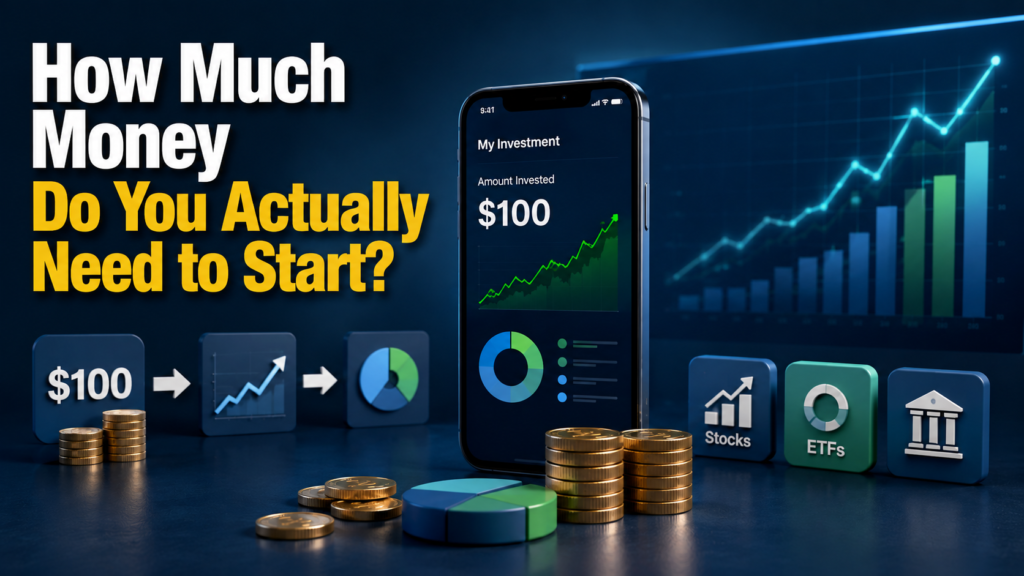
For many beginners, $50 to $100 can be enough to start investing if their brokerage and chosen investment allow small purchases or fractional shares.
Some brokerage accounts have no minimum investment requirement, while others may require a minimum amount for particular mutual funds or investments.
For example, you could theoretically invest $100 in an eligible investment and then continue adding $25 or $50 each month.
The amount itself isn’t the most important part.
Developing a habit of investing consistently can matter much more over the long term.
The Securities and Exchange Commission (SEC) encourages investors to understand their goals, risk tolerance, fees, and investment options before putting money into the market.
You Don’t Need to Buy a Whole Stock
A common reason people think investing requires thousands of dollars is the price of individual shares.
Suppose a stock costs $400 per share. If your brokerage offers fractional shares, you may not need $400 to invest in it.
You might be able to invest $20, $50, or another smaller amount and own a fraction of one share.
Fractional shares can make investing more accessible to beginners, although availability and rules vary between brokers and investments.
This is one reason I wouldn’t wait until I had a large amount of money sitting around before learning how investing works.
Starting small can give you an opportunity to understand how your account works, how investments fluctuate, and how comfortable you are with market risk.
Start With Your Financial Foundation
Here’s where I think beginners should slow down.
Just because you can invest $50 today doesn’t necessarily mean you should.
Before putting significant amounts of money into investments, consider whether you have enough cash available for emergencies and whether you’re carrying expensive debt.
The CFPB recommends building emergency savings to help handle unexpected expenses and financial shocks.
Imagine investing $2,000 and then needing $1,500 unexpectedly for a car repair or medical bill. If you don’t have cash available, you might be forced to sell investments at an inconvenient time.
For that reason, I prefer thinking about investing as one part of a broader financial plan rather than something that comes before everything else.
What About High-Interest Debt?
High-interest debt deserves attention before aggressively investing.
For example, credit-card balances can carry substantially higher interest rates than the expected long-term return of many investments.
That doesn’t mean you can never invest while paying off debt. Some people invest small amounts while simultaneously paying down debt.
But if you’re deciding where to put an extra $500, compare the interest you’re paying on your debt with the potential benefits of investing.
There isn’t one answer for everyone, but understanding the numbers can help you make a more informed decision.
You Can Start With a Retirement Account
You don’t necessarily need a regular taxable brokerage account to begin investing.
If you’re eligible, retirement accounts such as a 401(k) or IRA can provide a tax-advantaged way to invest for retirement.
If your employer offers a 401(k) with matching contributions, understanding the match should be high on your financial priority list. An employer match can provide additional money toward retirement when you contribute according to the plan’s rules.
For IRAs, the IRS sets annual contribution limits and eligibility rules that can change over time. Always check the current IRS guidance before making contributions.
The important thing is not to confuse the account with the investment.
An IRA is an account. Inside that account, you may be able to choose investments such as mutual funds, ETFs, or other eligible securities.
How Much Should You Invest Each Month?
Instead of asking only, “How much do I need to start?”, I think a better question is:
“How much can I consistently invest?”
Someone who starts with $100 and invests another $50 every month may build a stronger investing habit than someone who invests $2,000 once and never contributes again.
For example, you might choose:
- $25 per month
- $50 per month
- $100 per month
- $250 per month
- A percentage of each paycheck
The right amount depends on your income, expenses, debts, emergency savings, and goals.
Don’t choose an investment contribution that makes your monthly budget uncomfortable.
What If You Only Have $100?
That’s enough to begin learning.
With $100, you can open an eligible investment account and potentially purchase fractional shares or other low-minimum investments, depending on the brokerage.
But don’t expect $100 to turn into a fortune overnight.
The real value of starting with a small amount is developing the process:
- Open an appropriate account.
- Understand what you’re buying.
- Invest an amount you can afford to leave invested.
- Continue contributing regularly.
- Learn how fees and taxes work.
- Keep your long-term goal in mind.
Investing is generally a long-term activity. The SEC emphasizes that investors should consider their time horizon and risk tolerance when choosing investments.
What If You Have $1,000 to Invest?
Having $1,000 gives you more flexibility, but you still don’t need to rush into a complicated portfolio.
A beginner might use a diversified fund rather than trying to pick several individual stocks.
Diversification means spreading your money among different investments rather than concentrating everything in one company or asset.
The SEC notes that diversification can help reduce risk, although it cannot eliminate investment losses.
Before investing $1,000, I’d ask:
- Do I have emergency savings?
- Do I have high-interest debt?
- When will I need this money?
- How much loss could I tolerate?
- What is my investment goal?
- What fees will I pay?
Those questions are more important than trying to find the “perfect” stock.
How Much Should You Invest If You’re a Beginner?
There’s no universal percentage that works for everyone.
Some people start with 5% of their income. Others start with 10% or more. If your budget is tight, even a small amount can be a reasonable starting point.
For example, someone earning $4,000 per month might begin with $100 or $200 per month rather than immediately committing to a much larger contribution.
As income increases or expenses decrease, the contribution can increase.
The goal is to build a sustainable system.
Don’t Invest Money You’ll Need Soon
Your investment time horizon matters.
Money you need next month for rent should not be treated the same way as money you’re investing for retirement decades from now.
Stocks and other investments can rise and fall substantially over shorter periods. If you need the money soon, a market decline could leave you selling at a loss.
Before investing, consider when you’ll need the money and how much volatility you can tolerate.
The SEC recommends matching investment choices with your goals, time horizon, and risk tolerance.
Watch Out for Investment Fees
Fees can seem small, but they can reduce your long-term returns.
When comparing investments, look at expense ratios, trading fees, account fees, advisory fees, and other applicable costs.
The SEC provides investor resources explaining how fees and expenses can affect investment returns over time.
Don’t assume a fund is better simply because it has performed well recently.
Look at the total cost and understand what you’re actually buying.
What Should a Beginner Invest In?
There isn’t one investment that’s right for everyone.
Common choices include:
- Broad-market index funds
- ETFs
- Mutual funds
- Individual stocks
- Bonds
- Target-date funds
Your choice should depend on your goal, time horizon, risk tolerance, and knowledge.
For someone saving for retirement decades away, a diversified portfolio may make more sense than putting all their money into one company.
For a short-term goal, however, investments with significant market volatility may not be appropriate.
The Biggest Advantage Is Time
One of the most valuable things a young investor has isn’t a large amount of money.
It’s time.
Compounding means that investment returns can potentially generate additional returns over time. The longer your money remains invested, the more opportunity compounding has to work.
That doesn’t guarantee profits. Markets can decline, and investments can lose value.
But starting earlier can give you more time to contribute and potentially benefit from long-term growth.
So, how much money do you need to start investing?
For many beginners, the answer can be surprisingly small. Depending on the account and investment, $50 or $100 may be enough to get started.
But the more important question is whether you’re financially prepared to invest.
Build an emergency fund, deal with high-interest debt, understand your investment goal, and only invest money you can afford to leave invested according to your time horizon.
Then focus on consistency rather than trying to make a huge investment on day one.
You don’t need to wait until you’re wealthy to start learning about investing. You can start small, increase your contributions as your finances improve, and gradually build a long-term investment strategy that fits your goals.
The first $100 probably won’t change your financial life.
But learning how to manage and invest that $100 responsibly could be the beginning of a much more valuable financial habit.