Buying a car can be exciting until the monthly payment arrives and you realize it is much higher than expected. A payment that seemed manageable at the dealership can become a significant part of your monthly budget once you add insurance, fuel, maintenance, and other household expenses.
If your car payment is too high, the problem isn’t always the vehicle price alone. Your interest rate, loan term, down payment, taxes and fees, trade-in balance, and credit profile can all affect the final payment.
The good news is that there are several ways to understand why your payment is high and potentially reduce your costs.
Why Is My Car Payment So High?
Your monthly car payment is primarily determined by three things: how much you borrowed, your interest rate, and how long you have to repay the loan.
Other costs can also increase the amount financed.
These may include:
- Vehicle purchase price
- Sales tax
- Dealer fees
- Registration costs
- Optional products
- Negative equity from a previous car
- Interest charges
A high payment usually means one or more of these factors is working against you.
Before trying to lower the payment, look at your loan agreement and determine exactly how much you financed and what you’re paying for.
A High Interest Rate Can Increase Your Payment
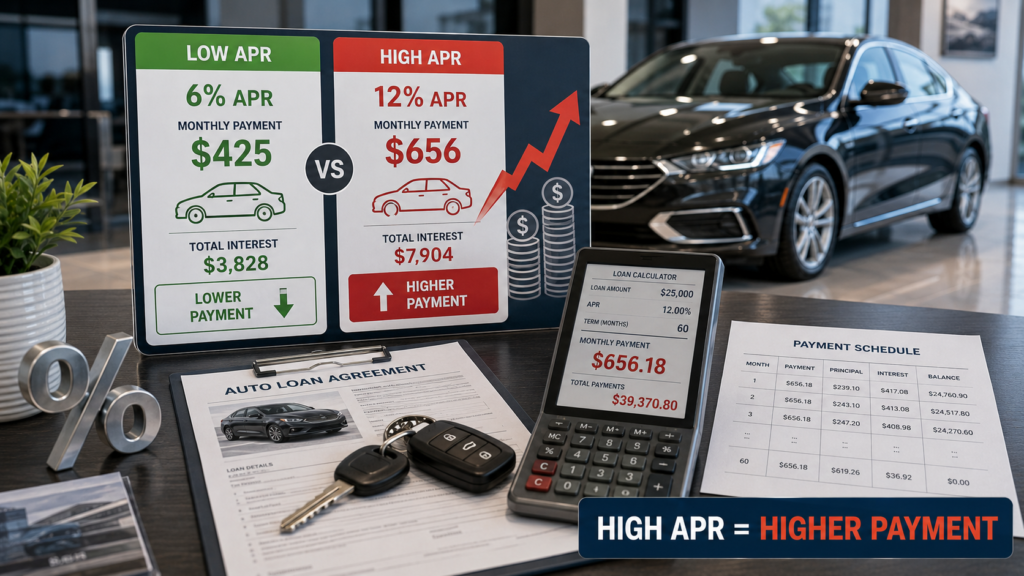
Your credit score and overall credit profile can have a significant impact on the interest rate you receive.
Borrowers with stronger credit may qualify for more competitive rates, while borrowers with weaker credit may receive higher rates because the lender considers the loan a greater risk.
Consider a simplified example.
If you finance $30,000 at a relatively high APR, you’ll pay considerably more interest than you would on the same amount at a lower APR.
This is why two people buying similar vehicles can have very different monthly payments.
Your credit score isn’t the only factor lenders consider, but improving your credit over time can potentially give you better financing options.
You May Have Borrowed Too Much
Sometimes the simplest explanation is that the vehicle costs more than your budget comfortably supports.
A $45,000 vehicle will generally require more financing than a $25,000 vehicle.
Even if a dealer makes the higher-priced vehicle seem affordable by extending the loan term, you’re still taking on a larger financial obligation.
When determining whether a car is affordable, don’t look only at the monthly payment.
Consider the complete cost of owning the vehicle, including:
- Loan payment
- Insurance
- Fuel
- Maintenance
- Repairs
- Registration
- Parking
- Taxes and fees
A vehicle that consumes too much of your monthly income can put pressure on other financial goals.
Your Loan Term May Be Too Short
A shorter loan term generally means higher monthly payments.
For example, paying off a $30,000 loan over four years will require larger monthly payments than paying the same balance over six years, assuming the same interest rate.
The advantage of a shorter term is that you may pay less total interest.
So a high payment isn’t necessarily a sign that you got a bad loan.
You may simply have chosen a shorter repayment period to reduce the total cost of borrowing.
Your Loan Term May Be Too Long
The opposite problem can happen with a long-term loan.
Extending a car loan can lower the monthly payment, but you’ll generally make payments for a longer period and may pay more interest.
Long loans can also increase the risk of becoming upside down on the vehicle.
Being upside down means you owe more on the loan than the vehicle is currently worth.
This can become especially problematic if you want to sell or trade in the vehicle before the loan is paid off.
Your Down Payment Was Too Small
A down payment reduces the amount you need to finance.
For example, if a vehicle costs $35,000 and you put $7,000 down, you start with a smaller amount to finance than if you put only $2,000 down.
A larger down payment can reduce both your monthly payment and the total interest you pay.
However, using every dollar of your savings for a down payment isn’t necessarily a good idea.
You should still have enough money available for emergencies and unexpected expenses.
Your Trade-In May Have Increased the Loan
Trading in an old vehicle doesn’t always reduce the amount you need to finance.
If you owe more on your existing vehicle than it’s worth, you have negative equity.
For example:
- Existing loan balance: $20,000
- Trade-in value: $15,000
- Negative equity: $5,000
If that $5,000 is rolled into your new car loan, you’re effectively financing part of the old vehicle along with the new one.
This can significantly increase the new loan balance and monthly payment.
Taxes and Fees Can Add to the Amount Financed
The sticker price isn’t necessarily the final amount you pay.
Depending on where you live and how the transaction is structured, your purchase can include sales taxes, registration costs, dealer fees, and other charges.
Optional products can also increase the amount financed.
Examples may include:
- Extended service contracts
- Vehicle protection products
- Optional insurance products
- Dealer-installed accessories
If you financed these costs instead of paying them separately, interest may also be charged on the additional amount.
Review the final purchase agreement carefully to see exactly what was included.
Check Your Credit for Errors
If your credit score is lower than expected, check your credit reports for inaccurate information.
Look for accounts you don’t recognize, incorrect balances, inaccurate payment history, or other errors.
If something is incorrect, you can dispute inaccurate information with the appropriate credit reporting company.
Improving your credit won’t necessarily lower the interest rate on an existing loan automatically, but a stronger credit profile could help if you refinance later.
Consider Refinancing Your Car Loan
If your credit has improved since you purchased the vehicle, refinancing may be worth exploring.
Refinancing involves replacing your existing auto loan with a new one.
You may potentially qualify for a lower interest rate if your financial situation has improved.
For example, refinancing could make sense if:
- Your credit score has improved
- Your income is stronger
- Your current APR is high
- You have made consistent payments
- You still have a significant loan balance remaining
However, refinancing isn’t always beneficial.
Compare the new APR, loan term, fees, and total interest with your existing loan.
Be especially careful if the new loan dramatically extends the repayment period. A lower monthly payment doesn’t automatically mean you’ll spend less overall.
Make Extra Payments if Your Budget Allows
If your loan doesn’t have a prepayment penalty and your financial situation allows it, making additional principal payments can reduce the amount of interest you pay over time.
Even occasional extra payments may help shorten the repayment period.
Before doing this, check your loan agreement and ask your lender how additional payments are applied.
Some lenders allow extra payments to go directly toward principal, while others may handle payments differently.
Also make sure you’re not neglecting emergency savings or higher-priority debt.
Sell or Trade the Vehicle Carefully
If the payment is genuinely unaffordable, selling or trading the vehicle may be an option.
But first determine how much you owe compared with the vehicle’s current value.
If you owe more than the car is worth, you’ll need to understand how the negative equity will be handled.
Rolling negative equity into another vehicle can simply move the problem into a new loan.
In some cases, keeping the current vehicle and paying down the loan may be financially better than replacing it immediately.
Ask Your Lender About Your Options
If you’re struggling to make payments, don’t wait until you’ve missed several payments before contacting your lender.
Explain your situation and ask what options are available.
Depending on the lender and your circumstances, possible options could include payment arrangements or other forms of assistance.
However, any change to your loan can have financial consequences, so understand the new terms before agreeing to anything.
Don’t Ignore an Unaffordable Payment
A car payment that consumes too much of your income can affect your entire financial life.
You may have less money available for:
- Emergency savings
- Retirement
- Credit card payments
- Housing expenses
- Family expenses
- Other financial goals
If you’re consistently struggling to make the payment, the solution may not be as simple as finding a few extra dollars in your budget.
You may need to reconsider the vehicle, loan terms, or overall debt load.
How to Lower Your Car Payment
If your current payment is too high, consider these steps:
1. Find out exactly how much you owe.
Check your current loan balance, APR, and remaining term.
2. Review your credit.
A stronger credit profile may improve refinancing opportunities.
3. Compare refinancing offers.
Look at the complete cost rather than only the new monthly payment.
4. Avoid adding more negative equity.
Be cautious about rolling an existing loan balance into another vehicle.
5. Consider additional principal payments.
If financially practical, extra payments may reduce interest over time.
6. Review optional products.
Check your purchase documents to understand what products were included in the financing.
7. Consider whether the vehicle fits your budget.
If the payment remains unaffordable, downsizing may be worth considering.
A high car payment can result from several factors, including a high interest rate, expensive vehicle, small down payment, long-term debt, taxes and fees, or negative equity from a previous vehicle.
The first step is to understand why your payment is high rather than immediately looking for a quick fix.
If your credit has improved, refinancing could potentially lower your interest rate. If you have extra cash available, additional principal payments may reduce the total interest you pay. And if the vehicle itself is simply too expensive for your budget, selling or downsizing may ultimately be the better solution.
Most importantly, don’t judge an auto loan solely by its monthly payment. Look at the APR, loan term, total amount financed, and total repayment cost.
A lower payment can sometimes cost more over the long run, while a slightly higher payment on a shorter loan may save money overall.
If your car payment is putting pressure on your finances, addressing the problem early can give you more options and help prevent a temporary affordability problem from becoming a long-term financial burden.