Paying for college is rarely as simple as covering tuition. Once you add housing, books, transportation, fees, and other education expenses, the total cost can become difficult for many families to manage.
College Ave is one private lender students and families may consider when federal aid, scholarships, grants, and savings aren’t enough. But before applying, it’s important to understand how College Ave student loans work, what rates are currently advertised, who may qualify, and how the application process works.
One thing I would keep in mind when comparing private student loans is that the lowest advertised rate isn’t necessarily the rate you’ll receive. Your actual offer can depend on factors such as creditworthiness, the loan term, repayment option, and whether you apply with a cosigner.
What Is College Ave?
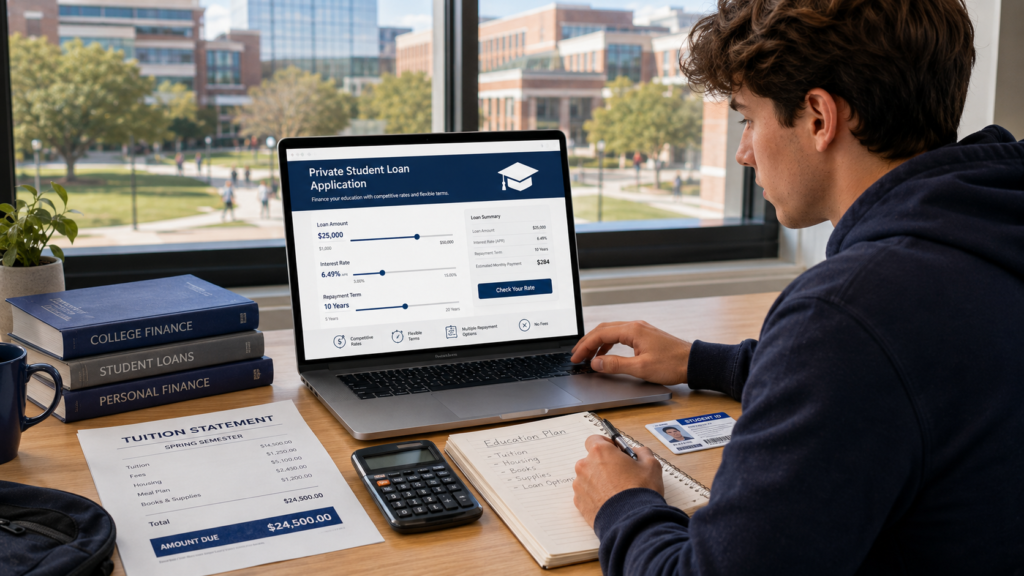
College Ave is a private student-loan company that offers financing for different types of education, including undergraduate, graduate, career, dental, and MBA programs. It also offers parent loans and student-loan refinancing.
Unlike Direct Subsidized and Direct Unsubsidized Loans, College Ave loans are private student loans, not federal student loans.
That distinction matters.
Federal student loans generally come with protections and repayment options that aren’t necessarily available with private loans. For that reason, students should generally look at scholarships, grants, and federal student aid before turning to private borrowing.
College Ave can make sense when there is still a funding gap after those options have been considered.
College Ave Student Loan Rates
As of August 18, 2026, College Ave advertises undergraduate student loan rates ranging from:
- Fixed APR: 1.94% to 17.99%
- Variable APR: 3.89% to 17.99%
The advertised rates include a 0.25% autopay discount. College Ave states that variable rates can increase after the loan is finalized, and the rate you actually receive depends on your creditworthiness and other underwriting factors.
These numbers are important, but I wouldn’t make a borrowing decision based only on the lowest advertised rate.
The 1.94% rate, for example, isn’t a promise that every student will qualify for it. The lender notes that approved rates depend on creditworthiness, and its lowest advertised rates are reserved for the most creditworthy borrowers and certain loan configurations.
That’s why checking your personalized offer is much more useful than simply comparing headline rates.
Fixed vs. Variable Rates
College Ave offers both fixed- and variable-rate student loans.
A fixed interest rate stays the same throughout the repayment period. This makes monthly payments easier to predict.
A variable interest rate can change over time because it is tied to a market index. College Ave explains that variable rates can fluctuate during the life of the loan.
For a borrower who values predictable payments, a fixed rate may be easier to budget for.
A variable rate may initially be lower, but there is more uncertainty because the rate can increase later.
Neither option is automatically best for every student. The important thing is understanding the potential cost before signing the loan agreement.
How Much Can You Borrow?
College Ave says its undergraduate loans can cover up to 100% of the certified cost of attendance, after accounting for other financial aid, with a minimum loan amount of $1,000.
That doesn’t mean you should borrow the maximum amount available.
If your school costs $30,000 and you can cover $22,000 through scholarships, grants, savings, and other aid, borrowing the remaining amount may be more sensible than taking an unnecessarily large loan.
Remember that every dollar borrowed today can become a future monthly payment.
College Ave Student Loan Requirements

College Ave doesn’t publish one universal credit-score requirement for every borrower because approval depends on individual underwriting.
According to current information from College Ave and independent lender reviews, applicants generally need to provide information about themselves, their school, education program, and finances. A borrower may also need a cosigner depending on their credit profile.
For undergraduate loans, commonly required information can include:
- Personal and contact information
- Date of birth
- Social Security number
- School information
- Expected graduation date
- Requested loan amount
- Income and financial information
- Cosigner information, if applicable
College Ave’s minimum eligibility criteria for undergraduate borrowers include being at least 16 years old, attending an eligible school, having a Social Security number, and meeting the school’s satisfactory academic progress requirements, according to Forbes Advisor’s current review of the lender’s requirements.
Meeting these basic requirements doesn’t guarantee approval.
Do You Need a Cosigner?
Not necessarily, but many undergraduate students may benefit from having one.
Students who haven’t established much credit history or don’t have substantial income can have difficulty qualifying on their own. A creditworthy cosigner may improve the chances of approval and potentially help the borrower qualify for a lower rate.
There is an important downside, though.
A cosigner isn’t simply someone who helps fill out the application. They are taking on responsibility for the debt. If payments aren’t made as agreed, the cosigner can be affected financially.
College Ave does offer cosigner release under certain conditions. Current information indicates that cosigner release may become available after 24 consecutive on-time monthly payments, subject to the lender’s requirements.
Always check the current loan agreement because eligibility conditions can change.
College Ave Repayment Options
One feature that makes College Ave worth comparing is the number of repayment options available.
For undergraduate loans, the lender currently lists four options:
Full principal and interest: Payments begin while you’re in school. College Ave says this option can save the most money over the life of the loan because you’re paying principal and interest sooner.
Interest-only: You pay the interest that accumulates while you’re in school.
Flat payment: You make $25 monthly payments while in school, according to the lender’s current terms.
Deferred payment: You don’t make required payments while you’re in school, but this generally results in more interest accumulating over the life of the loan.
This is an area where I would slow down before choosing an option.
The smallest monthly payment isn’t necessarily the cheapest option overall. If you can comfortably make payments while you’re still in school, paying earlier can reduce the amount of interest that accumulates.
How to Apply for a College Ave Student Loan
The application process is primarily online.
College Ave says its application takes about three minutes to complete and provides an instant credit decision in many cases.
A typical process looks like this:
Check Your Options
Start by looking at the type of loan you need and estimate how much you actually need to borrow.
Prequalify or Apply
College Ave offers a prequalification process that can allow eligible applicants to view potential rates without immediately completing a full application. Independent reviews report that the prequalification process uses a soft credit inquiry.
Add a Cosigner if Needed
If your credit history or income isn’t strong enough, you may have the option to apply with a qualified cosigner.
Select Your Rate and Repayment Terms
If approved, compare the available fixed or variable rate, repayment option, and loan term.
School Certification and Disbursement
After you accept the loan, College Ave works with your school to certify the amount before funds are disbursed according to the applicable process.
Is College Ave a Good Student Loan Option?
College Ave may be worth considering if you need a private student loan and want multiple repayment choices.
Its current offerings include undergraduate, graduate, career, dental, MBA, parent, and refinancing products, along with fixed and variable rates and several repayment options.
However, I wouldn’t call any private student lender automatically “the best” without comparing actual offers.
Look at:
- APR
- Fixed vs. variable rate
- Repayment term
- Monthly payment
- Total repayment amount
- Cosigner requirements
- Cosigner release rules
- In-school payment options
- Fees and penalties
- Available hardship protections
Most importantly, compare the offer with federal student aid before accepting private financing.
College Ave can be a useful option for students who need additional funding after considering scholarships, grants, savings, and federal student loans.
Its current advertised rates are competitive at the low end, but the range extends considerably higher, and your actual rate depends on your creditworthiness and loan details.
The biggest mistake would be choosing a private student loan simply because the advertised starting rate looks attractive.
Instead, get your personalized offer, compare it with other lenders, look at the total repayment cost, and make sure the monthly payment will be manageable after graduation.
College Ave itself notes that loan programs, rates, terms, and conditions can change, so borrowers should check the lender’s current disclosures before applying.